The customer sends a photo of a meal tray with a strand of carrot caught across the seal. The label is readable, so your quality team can trace the run. Your camera log shows rejects during that run. Production asks whether the inspection threshold needs tightening.
Then engineering runs a marked test tray through the line. The camera flags the defect, the pusher fires, and the tray behind it drops into the reject bin. The marked tray keeps going.
That is an illustrative scenario, and the distinction matters. Tightening the threshold could send more good trays to waste while leaving the suspect ones on the belt. Before changing the camera settings, find out how the defect could get from the line to the customer.
PMMI’s 2026 packaging equipment research identifies machine vision as one of the areas gaining momentum. For a plant buying or upgrading inspection, a useful question is what evidence the system will give you when a customer finds something it was supposed to catch.
Start with the pack the customer actually found
Get the complaint photo, product code, lot and time code if available. Recover the pack or compare with retained samples where possible. Establish what the defect is, which surfaces it affects and where it could have been introduced. A visible piece of product trapped during sealing calls for a different investigation from a corner damaged after case packing.
Use those details to narrow the search to the relevant production window. Pull the product recipe, installation settings, inspection records, stops and restarts, and any rework records for that run. A lot code can point you to the right shift without identifying a specific tray. If you cannot match the returned pack to a stored frame, say so. Reproducing an escape on an isolated trial can show that a failure path exists. It cannot prove that the returned pack took it.
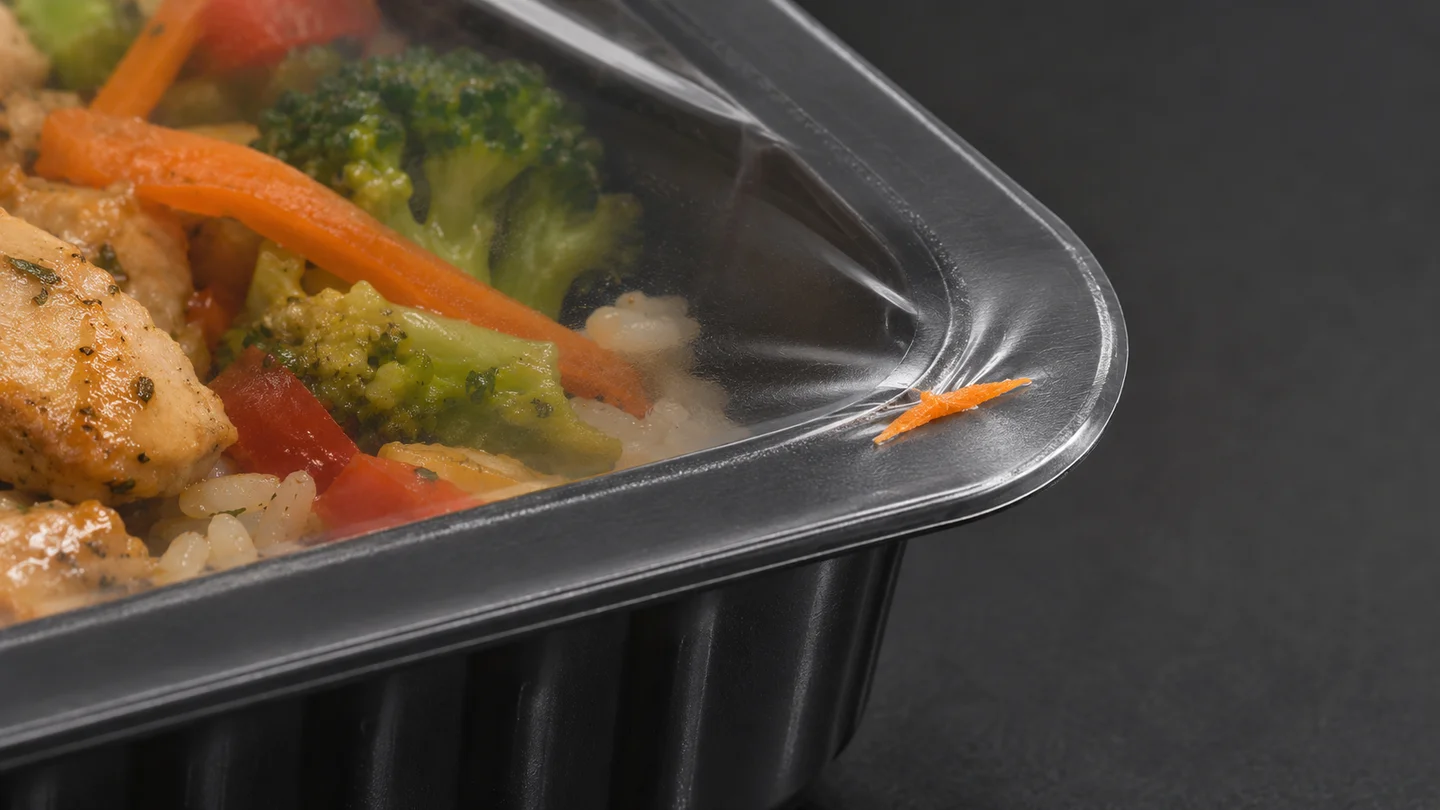
AI-generated illustration of visible product caught in the seal area. A photo alone cannot establish whether the pack leaks.
Where did the chain break?
The quality lead, controls engineer and operator can walk the same tray through four questions. Each answer points to a different fix.
| Question | Evidence to look for |
|---|---|
| Was the defect visible at the check? | The actual production image, with the inspected area marked. Look for glare, hidden corners, poor timing or damage that could have occurred after this station. |
| Did the check make the right decision? | The active product recipe, reference samples and the original result. Replay the recorded image against the settings that were in use. |
| Did the decision stay attached to the right pack? | The image trigger, pack tracking and reject command. Check what happens when packs bunch up, the belt changes speed or the line restarts. |
| Did the suspect pack leave the good stream? | Evidence at the reject station and downstream. An output in the PLC log is a command. A sensor on the cylinder shows movement. Neither alone identifies the tray that went into the bin. |
An inspection arranged around a date code and lid presence may pass a tray with material caught in the seal because the seal was never part of its job. Even with a seal check enabled, a shiny patch on the film can wipe out the detail on a corner. Look at the image before tuning a threshold. Lighting or a different viewing angle may make the feature measurable. If handling creates the damage later, move or add the check where it has a chance to see it.
Be precise about what the check can establish. A camera can look for visible material, wrinkles or missing film. Seal strength and leak performance are separate properties. Where those matter, use an appropriate validated physical test alongside the visual check. Cognex’s guide to packaging seal inspection shows examples of visible defects that vision can be set up to detect.
When the right result reaches the wrong tray
Imagine the reject pusher sits far enough downstream that several trays fit between it and the camera. The controls need to carry each decision forward to the moment its tray reaches the pusher.
At steady speed and spacing, a fixed delay can appear to work. After a stop, the conveyor accelerates and the spacing compresses. Now the pusher can hit the following tray. The camera reports a reject, the pusher cycles and the bin gets a tray. All three events can look normal in the shift totals. The mismatch only shows up when you follow the individual tray.
The fix depends on how the line moves. On a conveyor with predictable product movement, an encoder can help track travel distance. Where packs slip, accumulate or transfer between belts, add position checks or track packs through a controlled section. A reject confirmation sensor can verify that a pack entered the reject path, but the design still needs a way to associate that event with the expected pack. Test with a known bad tray immediately followed by a known good one so you can check both destinations. Reject confirmation is also covered in METTLER TOLEDO’s checkweighing guidance.
Then decide what the line should do if confirmation is missing, the bin is full, a camera returns no result or tracking is lost during a restart. Agree on the appropriate stop, divert or hold behaviour with quality and operations before commissioning. If you use a manual fallback, define where it happens, who owns it and how affected product is accounted for.
Test the good tray behind the bad one
A commissioning trial with one obvious defect, a clean lens and an empty belt is a starting point. The system earns its place when it can handle the variation that comes with a production shift.
- Build a set of known samples with quality. Include representative defects, borderline examples and acceptable packs with ordinary variation. Keep some samples out of setup so they can challenge the final settings independently.
- Run them at the conditions that make tracking and inspection hard. Include minimum and maximum production speeds, close spacing, consecutive rejects, and the first packs after a stop or product changeover. Use controlled test packs and account for all of them.
- Check the physical outcome. Did the bad tray leave the good stream? Did the good tray behind it stay on the line? Did the system flag missing images, missed rejects or loss of pack tracking as agreed?
- Report the outcomes separately. Show how many known bad test packs escaped and how many known good packs were rejected, with the denominators and conditions. A single accuracy percentage hides the difference. Zero escapes in a limited trial describes the trial and still leaves uncertainty about future production.
The same tests apply when a camera checks a connector before an assembly is closed, or a label before a carton goes to dispatch. Put the check where the feature is visible, tie the result to the right item and verify what happened to it.
Build a record you can investigate next time
For each inspection event you need to reconstruct, retain enough evidence to connect the product or batch, time, active recipe, decision and physical reject outcome. Save relevant images or clips where practical. Give the quality team a way to find them when a complaint arrives, and agree how long to keep them based on when complaints typically surface. If a stage only supports batch-level traceability, make that limit clear in the report.
At Zenaight, we build computer vision and inspection systems that connect what the camera sees to machine signals and production records. If a defect keeps getting through, bring us the sample and the line sequence. We can help you work out where to check it, how to verify removal and what evidence to keep for the next investigation.