Your next competitor could use the same machinery, buy from the same suppliers and sell to the same customers.
They could also spot production problems sooner, grade products more consistently and complete in minutes a workflow that takes your team an afternoon.
That is a competitive advantage you would feel in lead times, customer expectations and margins.
Much of the public conversation about AI centres on chatbots and office productivity. For businesses working with physical products, specialist equipment and complex operations, the opportunity is considerably broader. Cameras can inspect. Sensors can measure. AI can interpret patterns. Custom software can connect those capabilities to the way a business actually works.
The question for a specialised business is where that combination changes what it can deliver.
The opportunity is often hidden in a task everyone accepts
Every industry has tasks that seem too specific for a standard software package.
A metal component needs an unusual inspection. A processing line presents products inconsistently. A remote operation needs information from equipment that was never designed to share it. A quotation requires someone to interpret drawings, check specifications and pull information from several systems.
These tasks survive because experienced people make them work. As production grows, however, the time, inconsistency or limited coverage can become expensive.
Custom AI development gives businesses another option: build an application around the task and the expertise already inside the operation.
That could mean inspecting a feature at production speed, extracting information from technical documents, or identifying a change in equipment behaviour. The value comes from completing a commercially important task reliably enough to change the workflow around it.
Specialised knowledge becomes a development advantage
The person who understands which surface mark matters, which product variation is acceptable or which combination of signals deserves attention brings essential information to an AI project.
A generic model does not arrive knowing your customer's grading specification or how a particular machine behaves during a changeover. Your team's knowledge helps define the examples, decisions and exceptions the system must handle.
Over time, a business can build a valuable combination of labelled production examples, operating history, tested applications and effective responses. That foundation makes subsequent improvements easier to develop and assess.
A competitor can buy similar hardware. Reproducing a system shaped around years of operational knowledge takes more work.
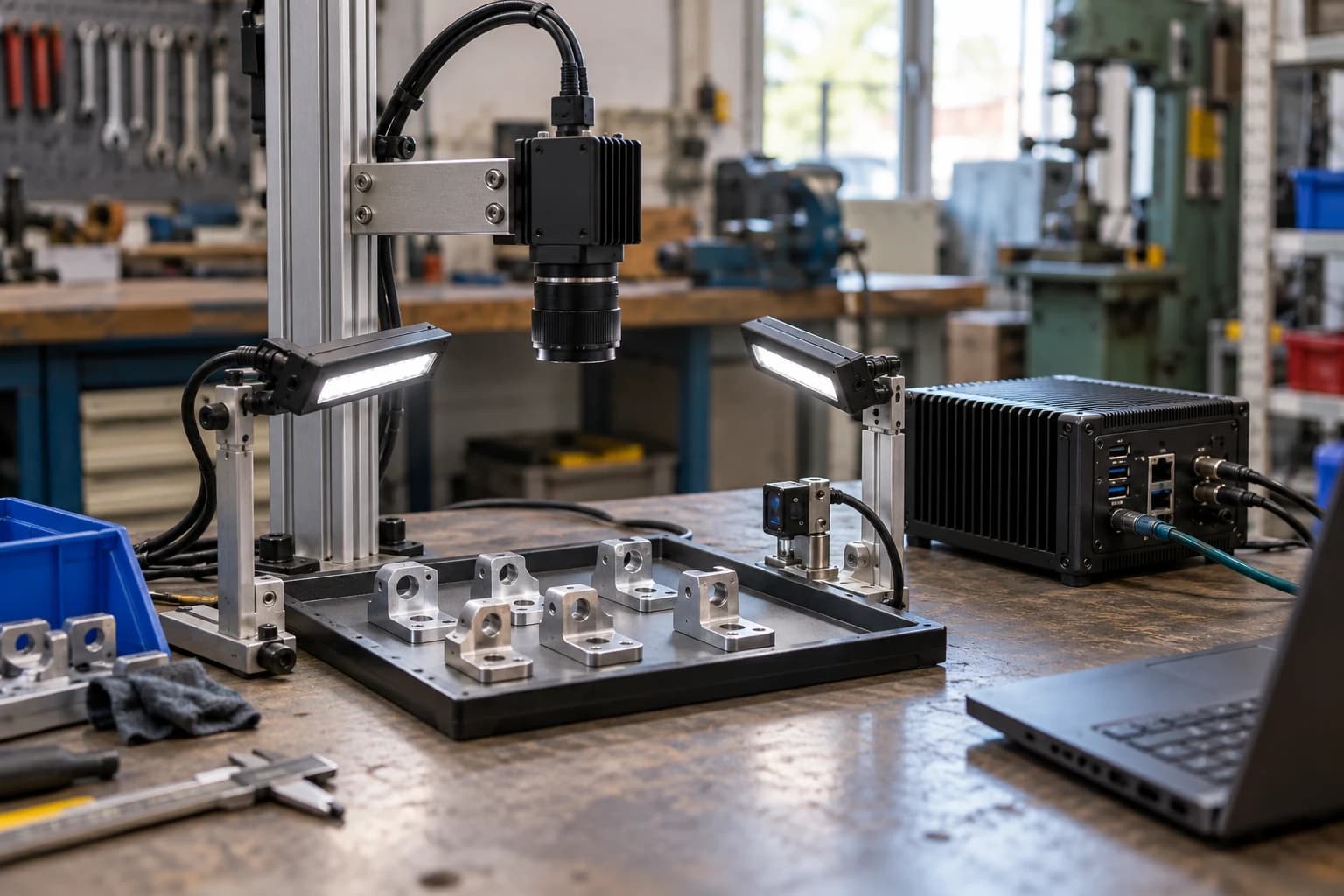
AI-generated illustration of a practical development setup; not a client installation.
Four ways AI changes what a specialist business can do
1. Inspect and grade at the point where a decision matters
Computer vision can evaluate visible product features against agreed criteria and connect the result to an operator, a sorting mechanism or a production record.
Applications span surface inspection in metals, carcass and portion grading in meat processing, fruit quality assessment, packaging checks and assembly verification.
The commercial benefit depends on the task: fewer defects escaping, more consistent grading, less unnecessary rework or better allocation of products to customer specifications.
For an operation handling several grades, understanding which product belongs where can be as important as identifying an outright defect. That is a strong reason to design the application around the production decision from the beginning.
2. Observe changes between manual checks
Some processes need attention long before a finished product reaches inspection.
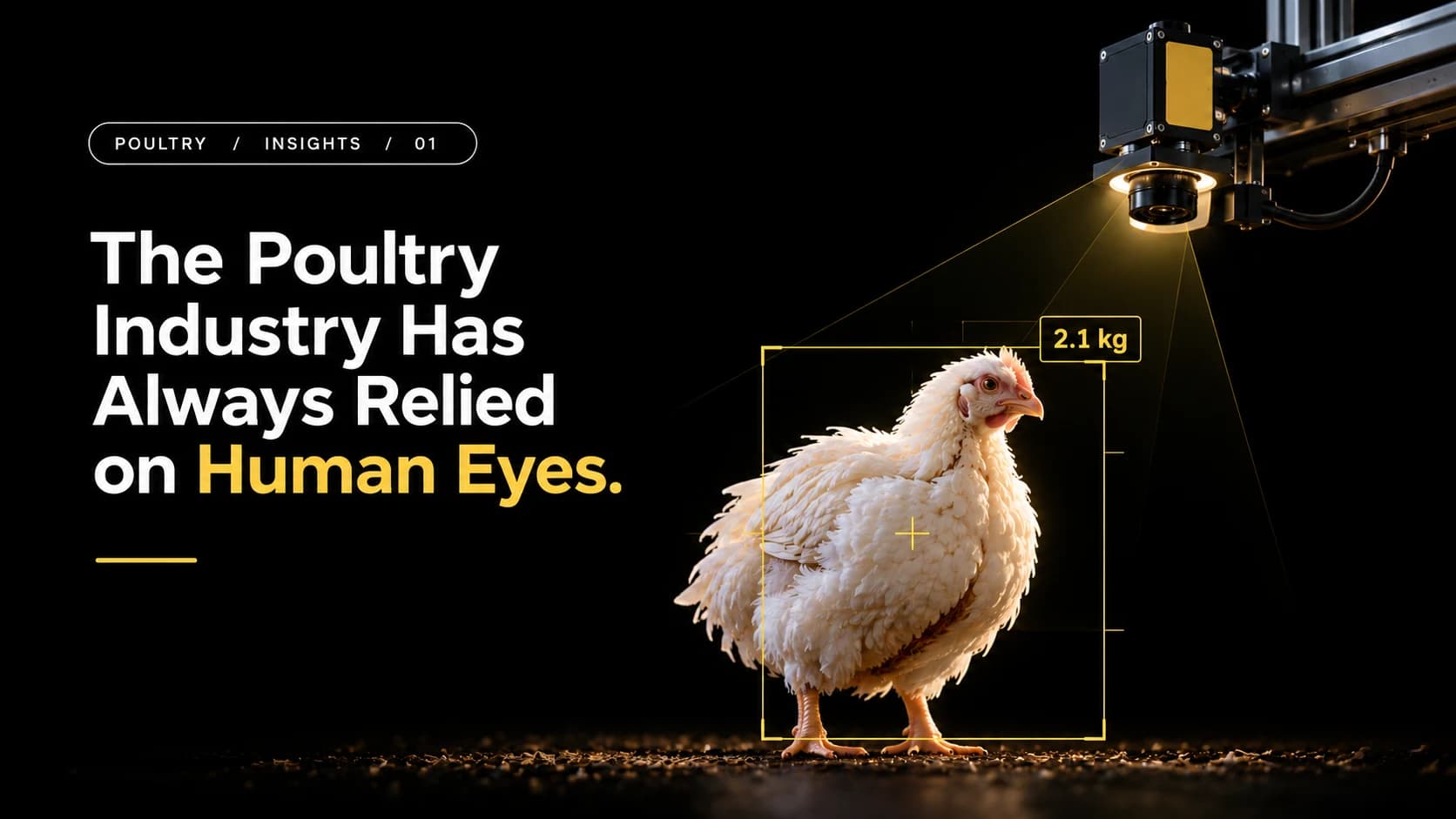
In a broiler house, cameras can analyse distribution, activity and feeding or drinking behaviour. In an industrial process, visual observations can be combined with temperature, vibration, pressure or flow measurements to identify changes worth investigating.
Behavioural observations and physical measurements serve different purposes. A camera observing activity near a drinker and a meter measuring water flow provide complementary information. Together, they give teams a stronger basis for deciding where to investigate.
For remote operations, on-site processing and suitable communications can keep those applications useful where a continuous cloud connection is impractical.
3. Connect specialist information to the next step
A technical document, inspection image or equipment reading often starts a much longer chain of work.
Someone captures the information, checks it, retypes it, sends it to another team and waits for a decision. Each handover consumes time and creates another opportunity for information to go missing.
AI-assisted extraction and custom software can connect the original input to a usable record, review queue or existing business system. For example, an application could extract specified fields from a job document, validate them against an order and prepare the next workflow step for approval.
The opportunity extends well beyond the factory camera. Businesses can improve the administrative and engineering work surrounding production too.
4. Build a new service around an existing capability
AI also creates opportunities to change what a business sells.
An equipment supplier could add condition monitoring to its service offering. A specialist inspection business could provide searchable image records alongside its findings. A manufacturer could give customers product-level inspection evidence where identification and tracking support it.
These are development opportunities, rather than promises that every operation needs the same product. Their importance is commercial: a business may be able to offer a service, response time or level of information that customers previously could not buy from it.
The most useful advances connect AI, software and the physical world
A model recognising an object is one part of a system. The complete application also needs reliable inputs, an operating environment and a useful output.
That is why custom AI projects often involve several disciplines:
| Capability | Its role in a working application |
|---|---|
| AI and computer vision | Interpret images, classify conditions, extract information or recognise patterns |
| IoT and embedded systems | Capture physical measurements, connect equipment and process information on site |
| Custom software | Manage users, records, workflows, interfaces and business-system integrations |
| Automation and integration | Connect a finding to an agreed response, with suitable controls and operator visibility |
This combined approach is already visible across the engineering sector. EPAM's GRAIN platform combines sensor inputs, cameras, local processing and software. deepsense.ai's computer vision projects span industrial inspection and other specialist image-analysis tasks. These external examples illustrate the breadth of applied AI; they are separate from Zenaight's work.
Where should a South African business start?
Start with a task whose improvement would matter to the business. Make it specific enough that the team can describe a successful result.
“Use AI in the factory” is difficult to scope. “Inspect this feature before the component reaches assembly and record the result against the job” gives engineers a task they can build and test.
A useful first application has four things:
- A meaningful business outcome: improved quality, less waste, faster turnaround or a service customers value.
- Accessible evidence: representative images, documents, measurements or operating records.
- A clear response: someone or something acts on the output.
- A way to measure success: performance against an agreed baseline under relevant working conditions.
A focused proof of concept can establish the difficult technical part. Production delivery then addresses the full operating requirements: integration, changing products, maintenance, connectivity and the people using the system.
Existing machinery does not automatically need replacing. Depending on the application, additional cameras, sensors and interfaces can extend the capability of equipment already on site. Our industrial computer vision cost guide explains the engineering involved in that delivery.
Disruption becomes real when an operation works differently
Adopting AI does not guarantee a competitive advantage. A working application earns that advantage by improving a task that matters, then sustaining that improvement in daily use.
The first project also teaches a business how to collect useful information, define its requirements and integrate intelligent systems. Those capabilities can support the next application. Waiting for a universal industry solution means postponing that learning as well as the initial improvement.
For specialised businesses, there is room to lead through expertise they already possess. The next step is turning a valuable part of that expertise into a system the operation can use.
Build the application your industry needs
Zenaight is a South African technology consultancy bringing together AI and computer vision, custom software development, and IoT and embedded systems.
Our work spans production inspection, monitoring, image-based information extraction and connected applications. We design around the task, develop the system and integrate it into the operation. Explore our selected projects for examples across these capabilities.
If your team has a difficult inspection, a specialist workflow or an idea for a connected product, bring us the problem. We can help turn it into a practical application and a business case for moving forward.