You can buy an industrial camera for a surprisingly reasonable amount of money.
Which creates an equally reasonable question when the full quotation arrives:
Why does the system cost so much more than the camera?
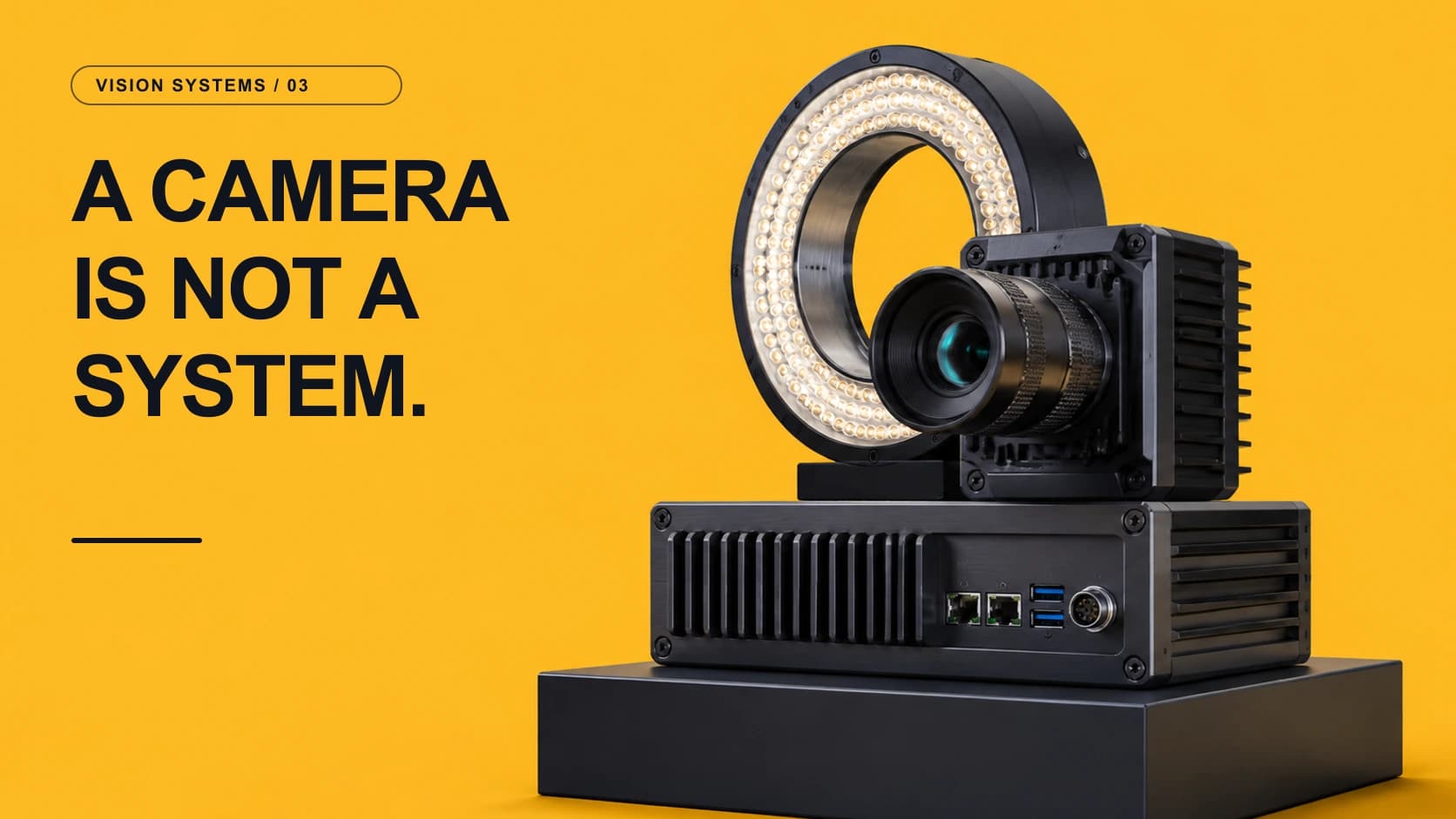
The short answer is that the camera is only the part that takes the picture.
It does not choose its own lens, design its lighting, mount itself above the line, train an AI model, speak to the PLC, store production records, survive a washdown area or explain to the production manager why it missed three products at 02:17 on a Tuesday morning.
Unfortunately, industrial cameras still do not come with a tiny engineer inside the box.
The cost of an industrial computer vision system is therefore less about the price of the camera and more about what has to happen between "we can see the product" and "the plant can rely on the result."
That gap is where most of the engineering lives.
So, what does a machine vision system cost in South Africa?
There is no useful single price for computer vision because the phrase can describe anything from one camera checking whether a label is present to several cameras tracking products across multiple production stages.
As a rough 2026 South African market benchmark, production-ready systems often fall into ranges similar to these:
| Type of system | Indicative budget |
|---|---|
| Single-camera inspection or counting station | R120,000 – R300,000 |
| Integrated multi-camera production system | R350,000 – R900,000 |
| High-speed, multi-station or highly complex system | R1,000,000+ |
These are not price-list numbers, and they should not be treated as a quotation from Zenaight. They are useful budgeting bands for understanding the scale of industrial machine vision projects.
A relatively simple system can fall below or around the lower end. A difficult retrofit with several cameras, custom AI, plant integration and significant mechanical work can move beyond these ranges quickly.
The important part is understanding why.
The camera is usually the easiest part to price
Cameras have model numbers.
Lenses have model numbers.
Industrial PCs have specifications.
Procurement departments like these things because they fit nicely into spreadsheets.
Engineering gets less tidy after that.
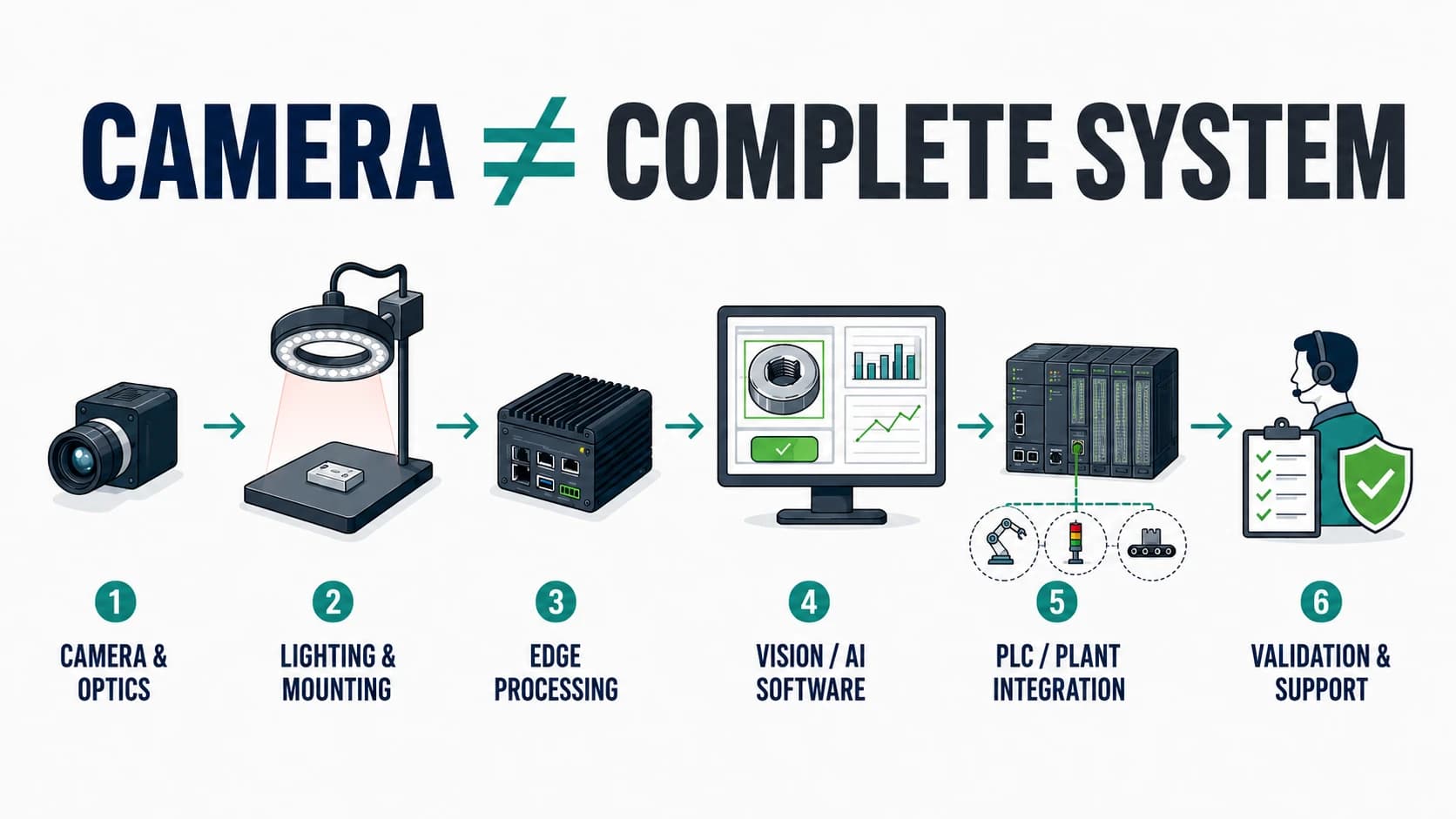
A production vision system normally includes some combination of:
- industrial cameras;
- lenses and optical filters;
- controlled lighting;
- mechanical mounting;
- protective enclosures;
- industrial or edge computing;
- AI models or machine-vision software;
- data storage;
- PLC or I/O integration;
- dashboards and reporting;
- networking;
- electrical work;
- installation;
- commissioning;
- validation;
- training;
- ongoing support.
Two suppliers can therefore quote for something both parties call a "vision system" while actually offering very different things.
One quotation may effectively mean:
Camera + software + basic setup.
Another may mean:
Installed, integrated and validated production system, including controls integration, event logging, operator interface and commissioning on the real line.
Comparing only the totals would be a little like comparing the price of an engine with the price of a roadworthy vehicle.
The engine is important.
You may still want the rest of the car.
What actually moves the price?
There are a few factors that change the cost of a computer vision project far more than the logo printed on the camera.
1. How difficult is the image?
If the product is large, well separated, consistent and moving through controlled lighting, life is easier.
If it is reflective, wet, glowing hot, partly hidden, moving quickly, covered in dust or occasionally travelling on top of another product, life becomes more interesting.
And, generally, more expensive.
Better lighting may be required.
More than one viewing angle may be required.
Faster cameras or shorter exposure times may be needed.
The mounting may need vibration isolation.
The system may need protection from heat, moisture or washdown.
One of the most expensive mistakes in machine vision is trying to solve a bad image with increasingly clever software.
Sometimes the best AI upgrade is a better light.
2. One camera versus understanding the whole process
Camera count matters, but not simply because each additional camera costs money.
Every extra viewpoint can also mean:
- more mounting;
- more cabling;
- more network capacity;
- more processing;
- more calibration;
- more data;
- more software logic;
- more failure scenarios to test.
If one camera can answer the question reliably, using four cameras because four feels more industrial is not an upgrade.
It is four cameras that now need to be cleaned.
3. The AI model may not be the expensive part
A demo model can sometimes be trained surprisingly quickly.
A production model is a different job.
It needs representative data.
That means seeing the process during normal production, unusual production, start-up, shutdown, product changeovers and the awkward scenarios that caused the problem in the first place.
The work is often not simply:
Train model → install model → finished
It is closer to:
Capture → label → train → test → find failure case → collect more data → retrain → validate → monitor
The more variable the process, the more effort is normally required to make the system dependable.
This is also why a ten-second demo clip should never be confused with a production acceptance test.
4. Integration can cost more than people expect
This is the part that often disappears from early budgeting.
What must happen after the camera makes a decision?
If the answer is simply "show it on a screen", integration can be fairly light.
If the answer is:
"Compare it with the PLC count, associate it with the current batch, save the image, raise an exception, update the production dashboard and send an approved signal back to the control system."
then you are no longer buying a camera project.
You are building part of the production system.
PLC communications, 24 V I/O, SCADA, databases, existing factory networks, APIs, reject mechanisms and line-control logic all require engineering. This becomes especially important in applications such as production-line counting with computer vision, where the vision result must reconcile with the wider process.
Older equipment is not necessarily a problem either. Plenty of perfectly good plants run equipment that has been operating reliably for many years.
It just means someone may eventually meet a PLC that was installed before some of the engineers working on the project finished primary school.
Usually it can still be integrated.
It may simply require a little more conversation.
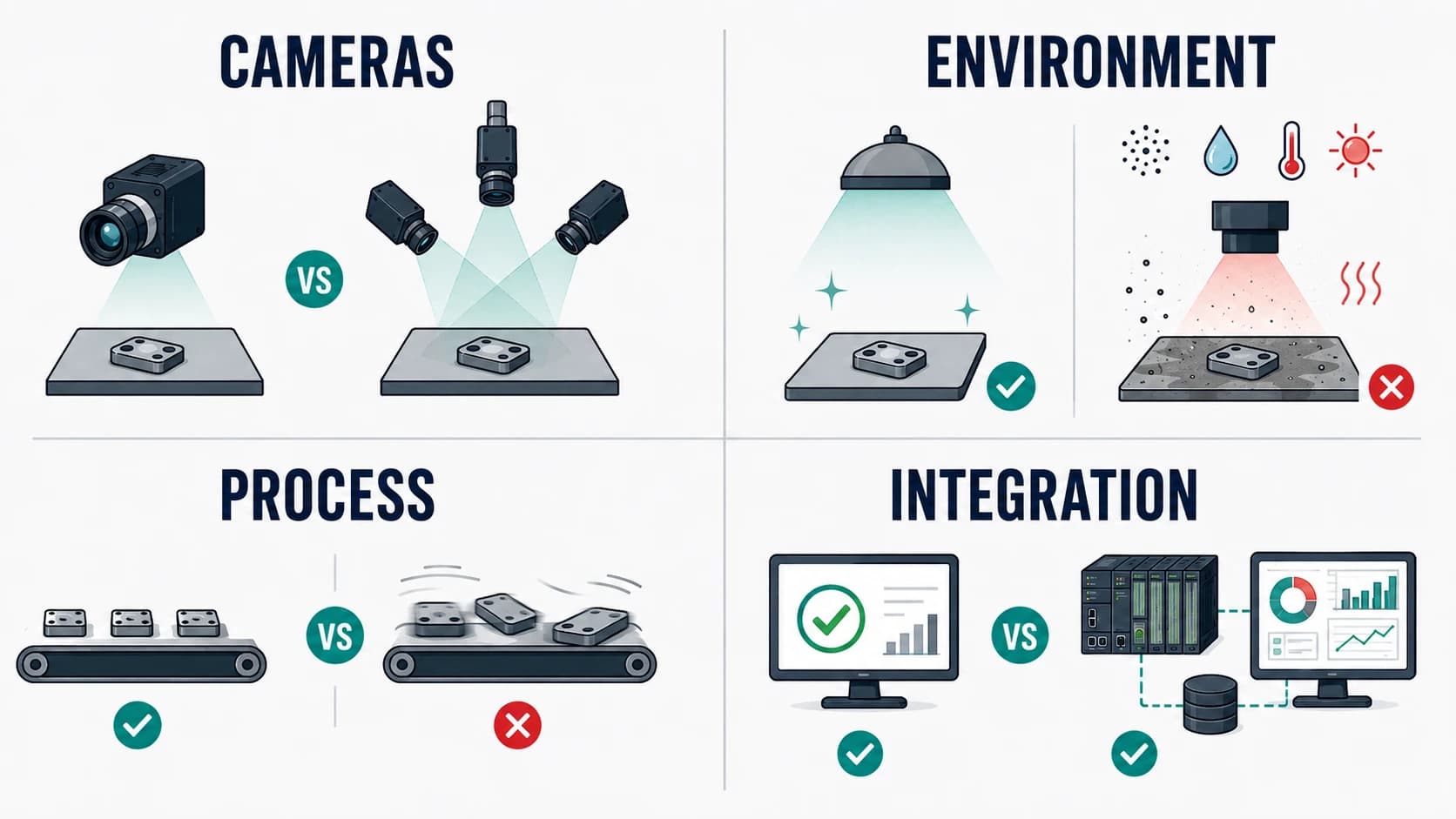
5. A proof of concept is not the same thing as a production system
This distinction matters when comparing prices.
A proof of concept should answer:
Can this problem realistically be solved with vision?
It might use temporary mounting, captured footage, a limited dataset and a basic interface.
That is perfectly acceptable if that is what everyone agreed to buy.
A production system has a different job.
It must keep working.
It needs proper hardware, mounting, environmental protection, recoverability, logging, commissioning, production testing and a plan for what happens when something changes.
A cheap proof that demonstrates feasibility is useful.
A cheap proof being quietly treated as though it is already a finished industrial system is where projects get into trouble.
The costs that tend to get forgotten
The initial installation is not the only number worth asking about.
Decision-makers should also understand the expected lifecycle cost.
That can include:
- software licences or subscriptions;
- support agreements;
- spare cameras or critical components;
- cleaning and maintenance requirements;
- model updates when products change;
- revalidation after major line changes;
- storage requirements;
- remote support connectivity;
- operator and maintenance training.
Some systems have significant recurring licence fees.
Others are largely owned outright and have relatively small ongoing costs.
Neither model is automatically wrong.
The problem is discovering the difference after the capital expenditure has already been approved.
How should you compare two computer vision quotations?
Do not start with:
"Which one is cheaper?"
Start with:
"Are these actually quoting the same outcome?"
A useful comparison should ask whether each proposal includes:
Imaging
- Camera
- Lens
- Lighting
- Mounting
- Environmental protection
Processing
- Edge computer or controller
- AI / vision software
- Software licences
- Storage
Integration
- PLC / I/O
- Existing sensors
- Database or production system
- Dashboard or reporting
- Reject or intervention interface where required
Delivery
- Installation
- Commissioning
- Production testing
- Acceptance criteria
- Documentation
- Training
After go-live
- Warranty
- Support
- Software updates
- Model retraining
- Call-out costs
- Recurring licence fees
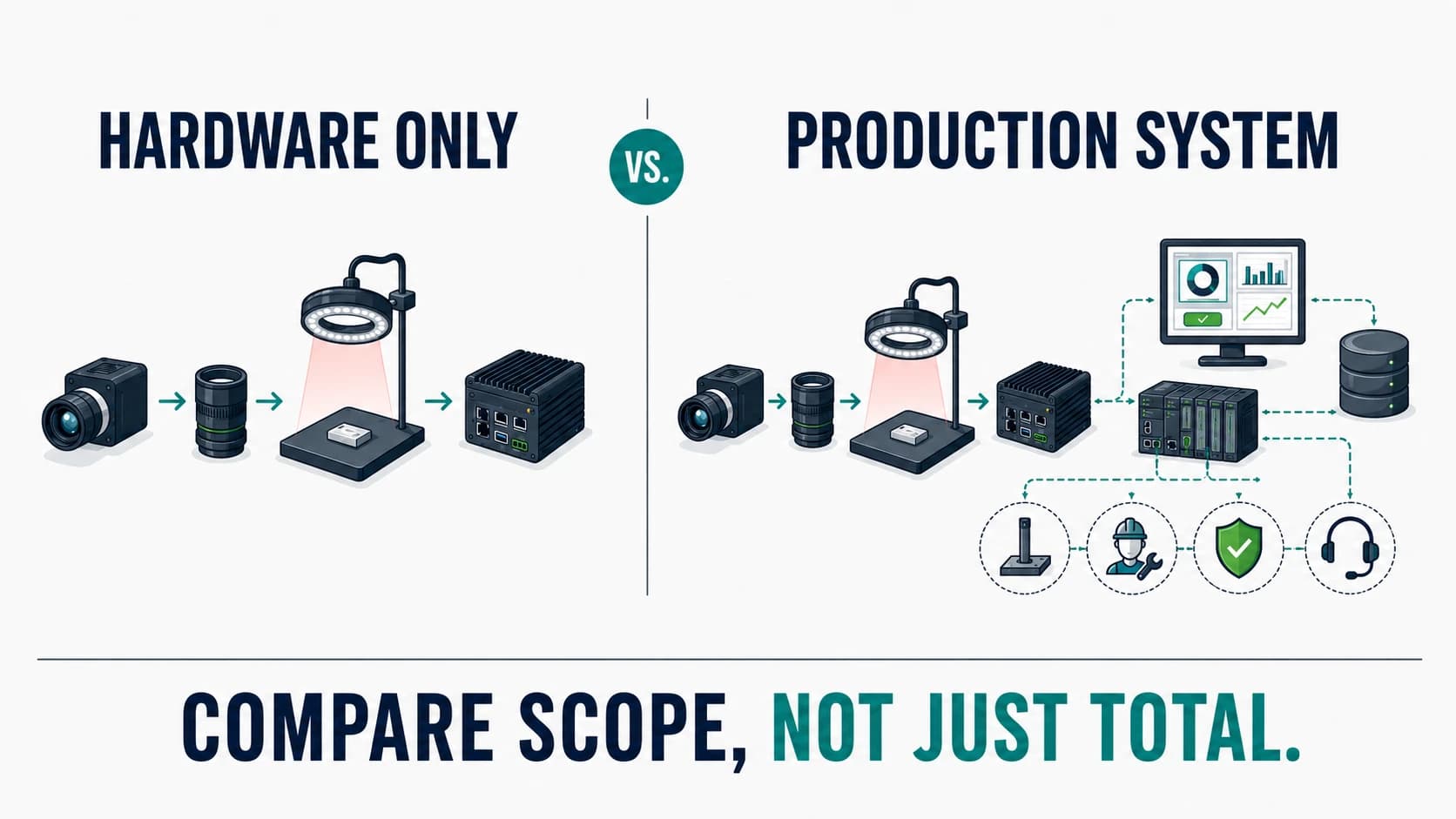
A R180,000 proposal and a R300,000 proposal are not necessarily expensive and cheap versions of the same thing.
Sometimes they are two completely different scopes sharing the same project title.
Start with the cost of the problem
This is where the conversation becomes more useful for management.
A R300,000 system is expensive if it solves a R20,000-per-year problem.
It may be extremely cheap if the existing problem creates R1 million per year in giveaway, scrap, labour, customer claims or production losses.
So before asking what computer vision costs, quantify what the current problem costs.
That might include:
- product giveaway;
- rejected batches;
- scrap and rework;
- manual inspection labour;
- reconciliation time;
- production downtime;
- retailer or customer penalties;
- claims;
- traceability investigations;
- lost throughput.
Not every benefit has to be converted into a heroic five-decimal-place ROI calculation.
But there should be enough information to determine whether the project makes commercial sense.
Sometimes the answer will be no.
That is useful information too.
Where it is worth spending money
There are a few areas where cutting cost aggressively can become expensive later.
Good imaging.
Stable lighting and a sensible camera position make everything downstream easier.
Mechanical installation.
A brilliant algorithm attached to a vibrating bracket is still attached to a vibrating bracket.
Validation.
The system should be tested against agreed real-world conditions, not only the examples used to develop it.
Integration.
If production needs the information, make sure the information can actually reach production.
Supportability.
Someone eventually has to maintain the thing.
And where you may not need to spend it
More technology is not automatically better.
You may not need:
- a 4K camera when lower resolution provides the required detail;
- cloud infrastructure for a system that can run perfectly well at the edge;
- six cameras when one well-positioned camera solves the problem;
- years of video storage when only exceptions need to be retained;
- custom AI when conventional machine-vision rules will work;
- computer vision at all when a well-positioned R500 sensor solves the problem.
That last one is worth remembering.
The objective is not to buy computer vision.
The objective is to solve the production problem.
The number that matters is the installed system cost
When budgeting for an industrial computer vision project, asking "What does the camera cost?" is a reasonable starting question.
It is just not the question that determines whether the project succeeds.
A better question is:
What will it cost to get from seeing the process to producing information the operation can trust?
That includes the camera.
It also includes everything required to make the camera useful at 02:17 on that Tuesday morning we mentioned earlier.
At Zenaight, we approach AI and computer-vision systems as complete operational systems: imaging, AI, edge computing, software, PLC and sensor integration, dashboards, validation and support.
Because in a factory, the most expensive camera is often not the one with the highest purchase price.
It is the one that never quite becomes part of production.